
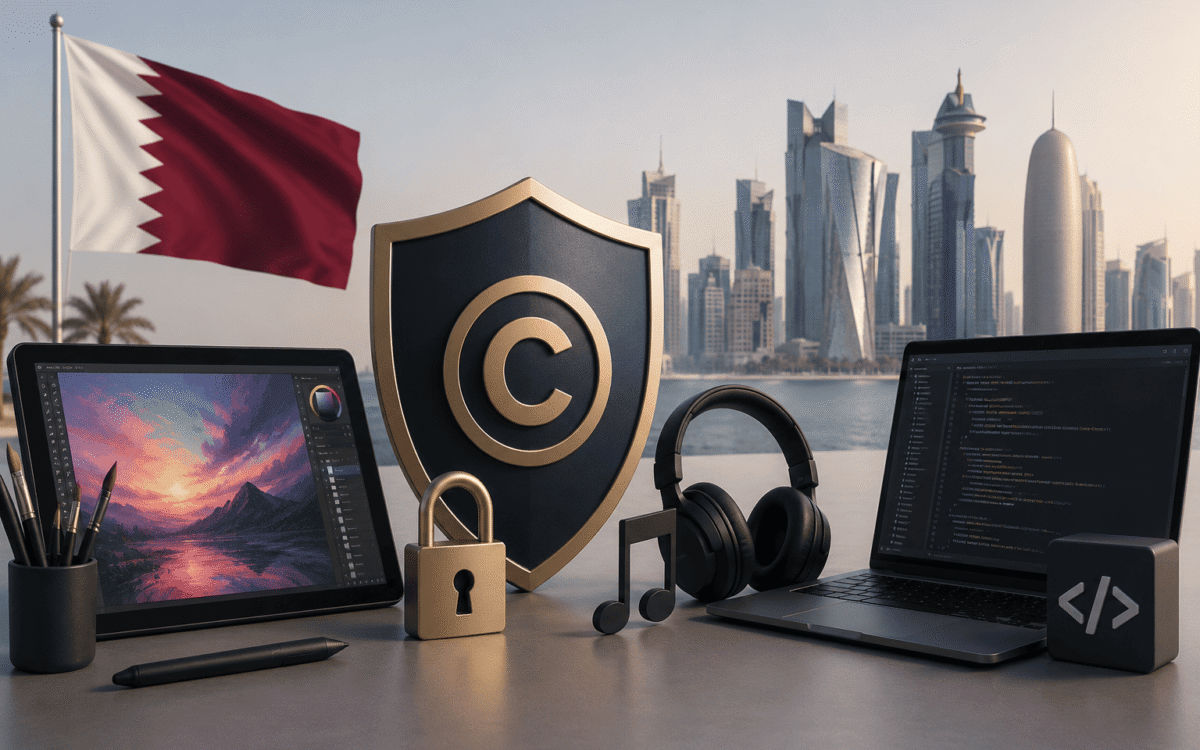
Copyright Protection for Digital Art, Music, and Software in Qatar
Qatar’s creative economy is growing rapidly. Digital artists, independent musicians, software developers, and content creators are building careers and businesses in one of the Gulf’s most dynamic markets. Yet many of them remain unaware of the legal protections available to them, or how to use those protections effectively.
Whether you are a freelance illustrator selling digital prints, a music producer licensing tracks, or a tech startup protecting proprietary code, copyright law in Qatar has significant relevance to your work. This guide explains exactly how it applies to digital art, music, and software, and what you need to do to protect what you have created.
Qatar’s Copyright Legal Framework
The Primary Law
Qatar’s primary copyright legislation is Law No. 7 of 2002 on the Protection of Copyright and Neighbouring Rights. This law safeguards original works across various domains, including literature, art, music, and software.
The law has since been supplemented by Law No. 10 of 2021, which brought additional alignment with international standards and addressed emerging issues in the digital environment.
Copyright Protection for Digital Art in Qatar
What Rights Does a Digital Artist Have?
As the creator of an original digital work, you hold exclusive rights to:
- Reproduce your work in any form, including printing or digital copying
- Distribute it to the public
- Display it publicly, whether online or in exhibitions
- Adapt or modify it into derivative works
- Licence it to third parties under agreed terms
- Transfer ownership through assignment
These rights are both economic (the right to derive income) and moral. Moral rights include the right to be identified as the author and the right to object to derogatory treatment of your work. These rights exist independently of economic rights and cannot simply be contracted away.
Practical Risks for Digital Artists
The digital environment creates specific vulnerabilities for visual artists in Qatar. Common infringement scenarios include:
- Screenshots or downloads of digital artwork being used without permission on social media
- Unlicensed reproduction of NFT art or digital illustrations in commercial marketing materials
- Websites or businesses using purchased images beyond the scope of the licence
- AI-generated derivatives of original digital work without authorisation
- Registration with the Ministry of Commerce and Industry (MoCI) provides evidence of ownership that is critical if any of these situations arise and you need to take action.
Copyright Protection for Music in Qatar
What Does Music Copyright Cover?
Music involves multiple overlapping layers of copyright. In Qatar, these can include:
The musical composition: the melody and harmony, owned by the composer
The lyrics: a separate literary work, owned by the lyricist
The sound recording: the master recording itself, owned by the producer or record label
Performances: performers have related (neighbouring) rights under Law No. 7 of 2002
This means that a single commercially released track may involve several different rights holders. For independent artists who write, produce, and perform their own music, all of these rights typically rest with them, making documentation of that ownership especially important.
Neighbouring Rights
Law No. 7 of 2002 specifically protects neighbouring rights, which cover the rights of:
- Performing artists in their performances
- Producers of sound recordings
- Broadcasting organisations
- These rights operate alongside, but separately from, the author’s copyright in the underlying composition.
Digital Distribution and Licensing
For musicians distributing work through streaming platforms, licensing music to businesses or media, or selling tracks online, it is vital to have clear contractual documentation setting out what the purchaser or licensee may and may not do. Copyright protection exists by law, but enforcement becomes far more straightforward when backed by written agreements and registration.
Copyright Protection for Software in Qatar
Is Software Covered?
Yes, explicitly. Under Law No. 7 of 2002, copyright protection is granted automatically without the need for formal registration. The law covers a wide range of original works, including books, lectures, computer programmes, architecture, and audiovisual content.
Computer programmes are treated as literary works under Qatari copyright law, consistent with the approach taken by most TRIPS-compliant jurisdictions and the WIPO Copyright Treaty.
What Does Software Copyright Protect?
For software developers and technology businesses in Qatar, copyright protects:
- Source code and object code
- Software architecture to the extent it is expressed in the code
- User interface elements that involve original creative expression
- Databases and structured data compilations
- Documentation, manuals, and technical writing
It does not protect the underlying idea or functionality, only the expression. If you want to protect the functional aspects of an invention, a patent may be the more appropriate route, though patent protection for software as such remains limited in Qatar.
Practical Considerations for Software Businesses
Tech startups and software companies operating in Qatar should consider:
- Registering copyright in key software products with the MoCI
- Using robust employment and freelancer contracts that clearly assign copyright to the company
- Implementing confidentiality and non-disclosure agreements for development teams
- Documenting the development process with version histories and timestamps to evidence ownership
Frequently Asked Questions
Do I need to register my digital artwork to be protected in Qatar?
No, copyright arises automatically when an original work is created and fixed. However, registration with the MoCI significantly strengthens your ability to enforce your rights. A registration certificate serves as formal evidence of ownership, which is invaluable if you need to take legal action against an infringer.
Is software protected by copyright in Qatar?
Yes. Computer programmes are explicitly protected as literary works under Law No. 7 of 2002. This covers source code, object code, and related documentation. The copyright protects the expression of the programme, not the underlying idea or functionality.
How long does copyright protection last in Qatar?
For works created by an individual, protection lasts for the author’s lifetime plus 50 years after death. For works created jointly, the 50-year period runs from the death of the last surviving author. For collective or anonymous works, protection lasts for 50 years from the date of first publication.
How Jitendra Consulting Qatar Can Help You
Protecting your creative work in Qatar requires more than knowing that copyright law exists. It requires a structured approach to registration, clear contracts, and expert support when enforcement becomes necessary.
Jitendra Consulting Qatar provides comprehensive intellectual property and legal consulting services to digital creators, creative businesses, technology companies, and entrepreneurs operating in Qatar.
Our Copyright Services Include:
- Copyright registration with the MoCI’s Intellectual Property Rights Protection Department for digital art, music, software, and other creative works
- Review and drafting of licensing agreements to ensure your terms protect your interests and generate appropriate value
- Employment and freelancer contract review to ensure copyright ownership is clearly established
- Non-disclosure agreement drafting for development teams and creative collaborators
- Advice on enforcing copyright against infringers, including complaint filing with the IPRPD
- IP strategy consultation to identify the full range of protections available for your creative assets
- Support with international copyright protection for Qatari creators operating across borders
Contact Jitendra Consulting Qatar today to arrange an initial consultation. Protect your creative work before someone else takes advantage of it.