
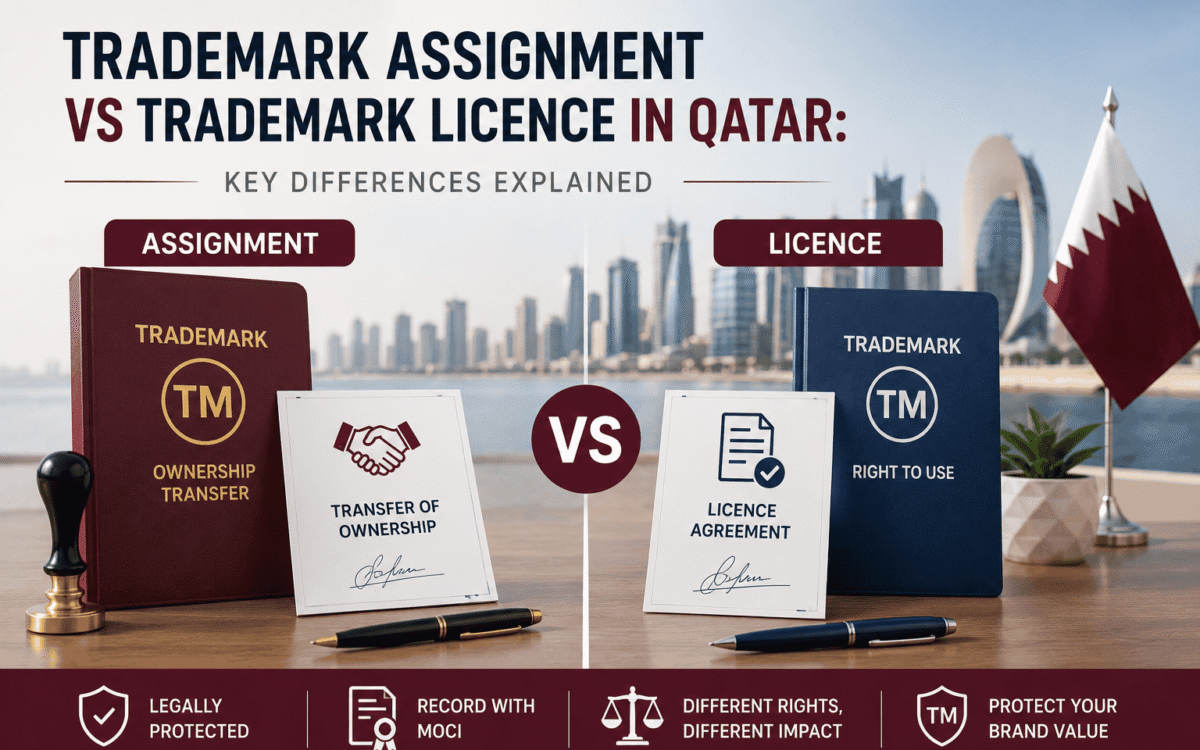
Trademark Assignment vs Trademark Licence in Qatar: Key Differences Explained
If you own a registered trademark in Qatar, you will eventually face a choice: should you transfer ownership of the mark outright, or allow someone else to use it while you retain control? These two routes, trademark assignment and trademark licence, are governed by different legal rules under Qatari law and carry very different commercial consequences. Understanding trademark assignment vs trademark licence in Qatar is essential before you sign any agreement, whether you are selling a brand, franchising a business, or entering a joint venture.
This guide explains both concepts under Qatar’s Law No. 9 of 2002 on Trademarks, Trade Names, Geographical Indications and Industrial Designs, and shows how to record either transaction correctly with the Ministry of Commerce and Industry (MOCI).
What Is Trademark Assignment in Qatar?
A trademark assignment is the permanent transfer of ownership of a registered mark from one party (the assignor) to another (the assignee). Once completed, the assignor gives up all rights to the mark, and the assignee becomes the new legal proprietor.
Key features of trademark assignment in Qatar:
- Full ownership rights pass to the assignee, including the right to use, licence, or further assign the mark.
- The transfer must be recorded in the Trademarks Register maintained by the Intellectual Property Office at MOCI to be effective and enforceable against third parties.
- Under Qatari law, an assignment will be considered null and void if it is likely to mislead the public as to the nature, source, or characteristics of the goods or services associated with the mark.
- Assignment documents typically require notarisation and legalisation, including translation into Arabic, before submission to the Trademarks Department.
- Assignment is commonly used in mergers, acquisitions, business sales, and corporate restructuring.
Because assignment is permanent, it should never be entered into without proper due diligence on the trademark’s registration status, any existing licences, and outstanding disputes.
What Is a Trademark Licence in Qatar?
A trademark licence is a contractual arrangement in which the proprietor (licensor) permits another party (the licensee) to use the mark, usually in exchange for royalties or fees, while retaining ownership.
Key features of trademark licensing in Qatar:
- Ownership stays with the licensor at all times; the licensee only gains a right of use, not a right of ownership.
- Licences can be exclusive, non-exclusive, or limited to specific goods, services, or territories within Qatar.
- The licence agreement should be recorded with the Trademarks Department to protect both parties and to demonstrate genuine use of the mark, which is particularly important given that a trademark can face a non-use cancellation risk after five consecutive years of non-use.
- Licensing is the standard structure for franchising, distribution agreements, and brand collaborations in Qatar’s retail, hospitality, and food and beverage sectors.
- The licensor typically retains the right to monitor quality and set conditions on how the mark is used, to protect brand reputation.
The Legal Framework: Law No. 9 of 2002
Trademark assignment and licensing in Qatar are governed primarily by Law No. 9 of 2002 on Trademarks, Trade Names, Geographical Indications and Industrial Designs, administered by the Intellectual Property Office within MOCI. A few points are especially relevant for businesses:
- A registered trademark is protected for ten years from the filing date and may be renewed indefinitely for further ten-year periods.
- The trademark owner has the exclusive right to prevent third parties from using the mark, or a confusingly similar sign, on identical or similar goods and services.
- Neither an assignment nor a licence is fully protected in law until it has been formally recorded with the Trademarks Department.
- An unrecorded transaction may be difficult to enforce against third parties and can create uncertainty in the event of a dispute.
Why Recording Your Assignment or Licence with MOCI Matters
Many businesses in Qatar sign a private assignment deed or licensing agreement and assume the job is done. In practice, the transaction only becomes legally robust once it is recorded on the official Trademarks Register. Recording:
- Provides public notice of the change in ownership or the licensing arrangement.
- Strengthens your position in any future infringement or ownership dispute.
- Is typically required when documents are legalised through a Qatari or Arab consulate abroad, then submitted alongside a power of attorney to the Trademarks Department.
- Helps demonstrate continuous, genuine use of the mark, reducing the risk of a non-use cancellation action.
Which Option Is Right for Your Business?
- Choose assignment if you are selling your business, exiting a market, or consolidating trademark ownership after a merger or acquisition.
- Choose a licence if you want to expand your brand’s reach in Qatar through franchising, retail partnerships, or distribution, while retaining control over quality and reputation.
- In some cases, businesses use both: an initial licence to test the Qatari market, followed later by an assignment as part of a broader corporate transaction.
Whichever route you choose, the agreement should be drafted carefully, reviewed against Qatari trademark law, and recorded promptly with MOCI.
Frequently Asked Questions
Is a trademark licence agreement legally binding in Qatar if it is not recorded with MOCI?
The agreement is binding between the parties as a matter of contract, but recording it with the Trademarks Department is important to make it fully enforceable against third parties and to protect the licensee’s position.
Can a trademark be assigned without the underlying business?
Yes, in principle a trademark can be assigned separately from the business, provided the assignment does not mislead the public as to the nature, source, or quality of the goods or services concerned.
How long does it take to record a trademark assignment in Qatar?
Timelines vary depending on documentation, legalisation requirements, and the Trademarks Department’s workload, so it is advisable to confirm current processing times before committing to a transaction timetable.
Can a trademark licence be exclusive to one licensee in Qatar?
Yes, licences can be structured as exclusive, sole, or non-exclusive, depending on the commercial terms agreed between the parties.
What happens if a trademark is not used for several years in Qatar?
A registered trademark that remains unused for an extended period may become vulnerable to a cancellation action on the grounds of non-use, which is one reason licensing arrangements are often recorded and documented carefully.
Get Expert Trademark Advice in Qatar
Whether you are transferring ownership of a trademark, negotiating a franchise licence, or protecting a brand you are bringing into the Qatari market, getting the legal structure right from the outset matters. Jitendra Consulting Qatar’s intellectual property team can advise on trademark assignment and licensing agreements, handle recordal with the Ministry of Commerce and Industry, and help you choose the structure that best supports your business goals.
Contact Jitendra Consulting Qatar today to discuss your trademark assignment or licensing requirements and safeguard your brand in Qatar.