
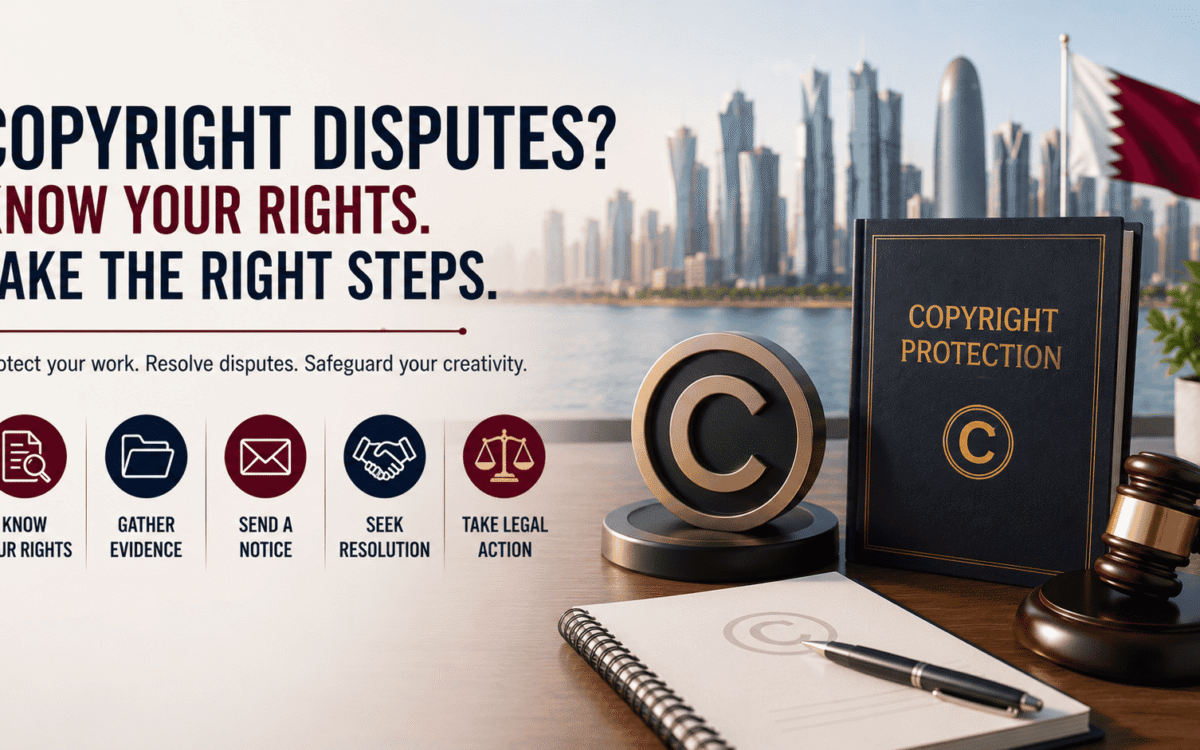
How to Handle Copyright Disputes: Tips for Qatar Creators and Businesses
Copyright disputes are becoming more common in Qatar as the creative economy grows and content moves online. Photographers, designers, writers, software developers and businesses across Doha and beyond are increasingly finding their work copied, repurposed or used without permission. Knowing how Qatari copyright law works, and how to respond when a dispute arises, can save creators and businesses significant time, money and reputational harm.
This guide explains the legal framework governing copyright in Qatar, the practical steps to take when a dispute occurs, and how to protect your creative or commercial work before problems arise.
What Qatari Law Says About Copyright Protection
Copyright in Qatar is governed primarily by Law No. 7 of 2002 on the Protection of Copyright and Neighbouring Rights. This legislation protects original works in literature, art, music, software and other creative fields, granting authors exclusive rights to reproduce, distribute and display their work.
Key features of the law include:
- Protection lasts for the author’s lifetime plus fifty years after death.
- Only the expression of an idea is protected, not the underlying idea, method or procedure itself.
- Moral rights (the right to be recognised as the author and to object to distortion of the work) are personal, perpetual and inheritable, but they generally require the author to be identifiable.
- Qatar does not recognise a general “fair use” defence, unlike some other jurisdictions, so unauthorised use is harder to justify.
Qatar is also a signatory to the Berne Convention, meaning foreign rights holders receive national treatment and their works are protected in Qatar in the same way as those of Qatari nationals. However, enforcing a foreign court judgment locally still requires recognition by Qatari courts, which can add complexity to cross-border disputes.
Common Causes of Copyright Disputes in Qatar
Copyright conflicts tend to arise from a small set of recurring situations:
- Reposting photographs, articles or designs on social media or websites without permission
- Using licensed content beyond the scope of the original agreement
- Employees or freelancers claiming ownership over work created for a client
- Businesses copying marketing materials, product descriptions or website content from competitors
- Misattribution of authorship, including claiming another creator’s work as one’s own
- Software or code reuse without a valid licence
Digital use of artwork and content is strictly regulated in Qatar, and reposting without permission generally amounts to infringement, even when no commercial gain is involved.
Steps to Take When a Copyright Dispute Arises
- Gather Evidence First
Before taking any action, collect and preserve evidence of your original work and the alleged infringement. This includes:
- Original files with timestamps or metadata
- Proof of first publication or creation date
- Screenshots or archived copies of the infringing use
- Any licensing agreements or contracts relevant to the work
- Check Your Registration Status
Copyright protection arises automatically in Qatar once a work is created, so formal registration is not mandatory. However, registering your work with the Ministry of Culture provides official recognition and stronger evidentiary support if a dispute reaches court. Registered works are generally easier to defend and settle, since ownership and creation date are already documented.
- Send a Formal Notice
A well-drafted cease and desist letter is often the fastest and least costly way to resolve a dispute. It should clearly identify the copyrighted work, explain the infringement, and request removal or compensation within a specific timeframe. Many disputes are resolved at this stage without further escalation.
- File a Complaint with the Ministry of Culture
If informal resolution fails, a complaint can be filed with the Ministry of Culture, which may mediate between the parties. Mediation is often quicker and less expensive than litigation and can preserve business relationships where appropriate.
- Pursue Civil or Criminal Action
Where mediation does not resolve the matter, rights holders can pursue action through the Qatari courts. Under Qatari law, infringement can lead to:
- Court-ordered damages to compensate for financial losses
- Injunctions to stop continued use of the infringing material
- Seizure of infringing goods or materials
- Fines or imprisonment in serious cases
How Businesses Can Reduce the Risk of Copyright Disputes
Prevention is significantly more cost-effective than dispute resolution. Businesses operating in Qatar should consider the following:
- Include clear intellectual property clauses in employment and freelance contracts, specifying who owns work created during the engagement
- Register key creative and brand assets with the relevant Qatari authorities
- Conduct periodic audits of marketing materials, website content and software to check licensing compliance
- Train staff and content teams on permitted use of third-party images, music and text
- Maintain records of original creation dates for important works
Frequently Asked Questions
Does copyright need to be registered in Qatar to be protected?
No. Copyright protection is automatic once a work is created and fixed in a tangible form. Registration is optional but strengthens your position in a dispute.
Can I use content under “fair use” for educational purposes?
Qatar does not recognise a general fair use defence as jurisdictions such as the United States do, so relying on this argument is risky. Permission or a valid licence is the safer route.
What happens if the infringer is based outside Qatar?
Cross-border enforcement is possible, particularly given Qatar’s membership of the Berne Convention, but enforcing a foreign judgment locally requires recognition by Qatari courts and can involve additional procedural steps.
How long does copyright protection last in Qatar?
Generally, for the lifetime of the author plus fifty years.
Protect Your Work Before a Dispute Happens
Copyright disputes are far easier to prevent than to resolve. Whether you are a designer, photographer, publisher or business owner in Qatar, having the right contracts, registrations and evidence in place can be the difference between a quick resolution and a costly legal battle.
Jitendra Consulting Qatar assists creators and businesses with copyright registration, licensing agreements, infringement complaints and dispute resolution across Qatar. If your work has been copied, misused or disputed, or if you want to put stronger protections in place, get in touch with our intellectual property specialists for tailored legal guidance.